


8th-Grade Geometry Essentials: Module 1
- quadrilateral
- interior and exterior angles of a quadrilateral
- types of quadrilaterals
- midsegment of a triangle
Quadrilateral
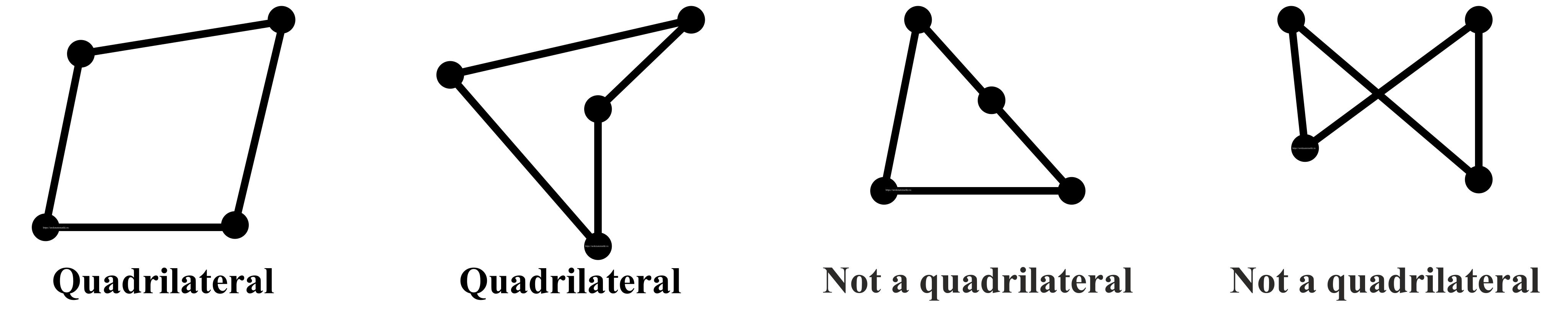
A quadrilateral is a figure consisting of four points and four line segments connecting them in sequence. No three of these points may lie on the same straight line, and the segments connecting them must not intersect. These points are called the vertices of the quadrilateral, and the segments connecting them are called the sides of the quadrilateral.

Vertices that are endpoints of the same side are called adjacent vertices, while vertices that do not belong to the same side are called opposite vertices. Sides sharing a common vertex are called adjacent sides, while those that do not share a vertex are called opposite sides. Segments connecting opposite vertices are called the diagonals of the quadrilateral. The points belonging to the quadrilateral divide the plane into two sets, forming two regions: the interior and the exterior.
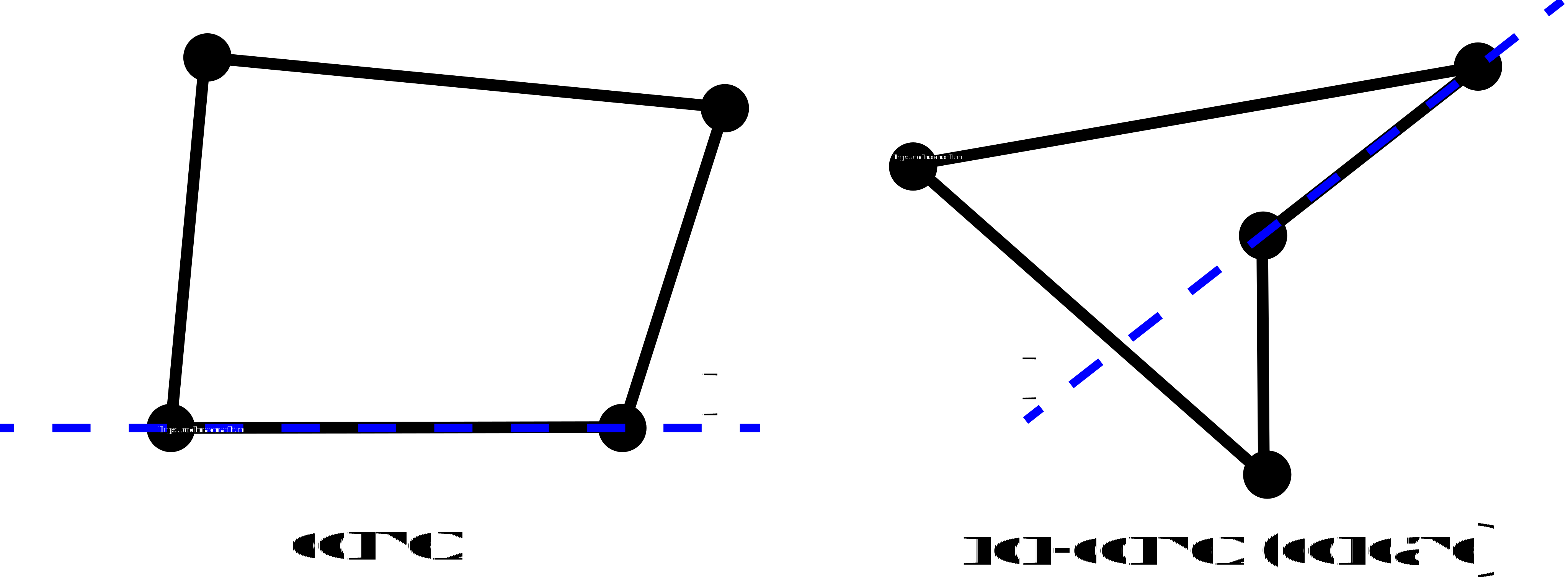
A quadrilateral is called convex if all points belonging to its interior lie in the same half-plane defined by the line containing any side of the quadrilateral; if these points lie in different half-planes, the quadrilateral is called non-convex (concave).

If any two points within the interior of a convex quadrilateral are connected, the line segment joining them lies entirely within the quadrilateral's interior. The diagonals of a convex quadrilateral lie within its interior. In a non-convex quadrilateral, one of the diagonals lies in the exterior region. Each of the two diagonals of a convex quadrilateral divides it into two triangles.
Interior and exterior angles of a quadrilateral

An angle adjacent to any angle of a convex quadrilateral is called an exterior angle. Two exterior angles can be formed at any vertex of the quadrilateral; these are vertical angles and are equal to each other. Therefore, when referring to the exterior angle of a quadrilateral, we mean one of these two. In the diagram, corresponding to the interior angles α, β, γ, δ, the angles α′, β′, γ′, δ′ are the exterior angles.
Each interior angle of a convex quadrilateral is less than 180°.

The measure of an interior angle of a non-convex quadrilateral can exceed 180°.

The sum of the interior angles of a convex quadrilateral is 360°.
Sum of the exterior angles of a convex quadrilateral

Theorem. The sum of the exterior angles of a convex quadrilateral, taking one at each vertex, is 360°.
Properties of sides
- Each side of a quadrilateral is shorter than the sum of the other three sides.
- The sum of the diagonals is less than the perimeter.
Types of quadrilaterals
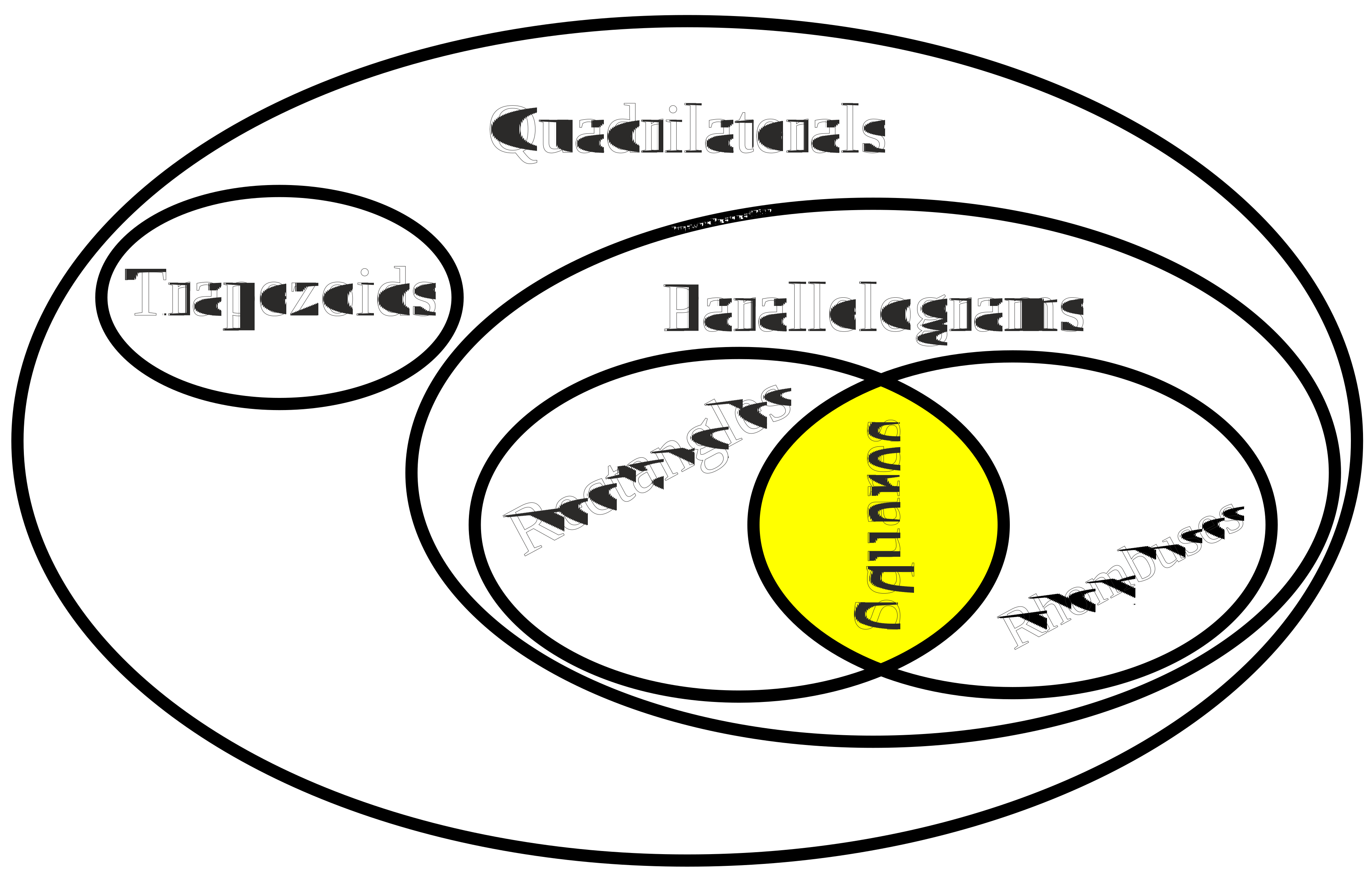
Parallelogram

A parallelogram is a quadrilateral in which opposite sides are parallel in pairs.
Properties of a parallelogram
- Opposite sides of a parallelogram are equal.
- Opposite angles of a parallelogram are equal.
-
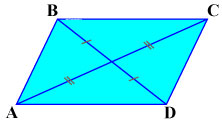 The diagonals of a parallelogram bisect each other.:
,
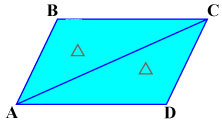 A diagonal divides the parallelogram into two congruent triangles: triangles ABC and CDA are congruent.
- The sum of adjacent angles is 180°.
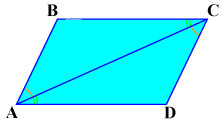 Alternate interior angles formed by a diagonal are equal.: ,
- The sum of all angles is 360°.
- An angle bisector cuts off an isosceles triangle from the parallelogram.
- The bisectors of angles adjacent to the same side of a parallelogram are perpendicular to each other.
- The bisectors of two opposite angles of a parallelogram are parallel.
- The perimeter of a parallelogram is equal to twice the sum of adjacent sides.
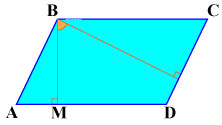 The angle between the altitudes drawn from the vertex of an obtuse angle is equal to the acute angle of the parallelogram.


Conditions for a parallelogram
- Two opposite sides are both equal and parallel.
- All opposite angles are equal in pairs.
- All opposite sides are equal in pairs.
- All opposite sides are parallel in pairs.
- Both diagonals bisect each other.
Rectangle

A rectangle is a quadrilateral in which all angles are 90° (i.e., right angles).
If one angle of a parallelogram is a right angle, then the parallelogram is a rectangle.
Properties of a rectangle
- A rectangle possesses all the properties of a parallelogram.
- All angles are right angles.
- The diagonals of a rectangle are equal in length.
- The perimeter of a rectangle is equal to twice the sum of its adjacent sides.
- The intersection of the angle bisectors of the interior angles of any parallelogram forms a rectangle.
Conditions for a rectangle
- If three angles of a quadrilateral are right angles, then the quadrilateral is a rectangle.
- If one angle of a parallelogram is a right angle, then the parallelogram is a rectangle.
- If the diagonals of a parallelogram are equal, then the parallelogram is a rectangle.
Rhombus

A rhombus is a quadrilateral in which all sides are equal.
A rhombus is a parallelogram in which adjacent sides are equal.
Properties of a rhombus
- Since a rhombus is a parallelogram, it possesses all the properties of a parallelogram.
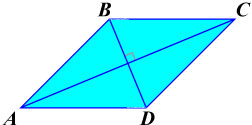 The diagonals of a rhombus are perpendicular to each other.: AC⊥BD.
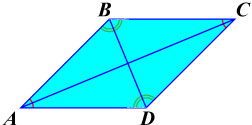 The diagonals of a rhombus also bisect its angles (divide the rhombus's angles in half).
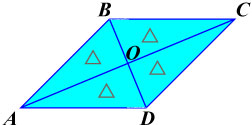 The diagonals divide the rhombus into four congruent right-angled triangles. Triangles ABO, CBO, CDO, and ADO are congruent right-angled triangles.
- The altitudes of a rhombus are equal.


Criteria for a rhombus
- If the diagonals of a parallelogram are perpendicular, then the parallelogram is a rhombus.
- If two adjacent sides of a parallelogram are equal, then the parallelogram is a rhombus.
- If the diagonals of a parallelogram bisect its angles, then the parallelogram is a rhombus.
- If all sides of a quadrilateral are equal, then the quadrilateral is a rhombus.
Square

A square is a quadrilateral in which all angles are equal and all sides are equal.
A square is a parallelogram that has a right angle and adjacent sides that are equal.
A square is a rectangle in which adjacent sides are equal.
A square is a rhombus that has a right angle.
Properties of a square
- A square possesses all the properties of a parallelogram, a rectangle, and a rhombus.
 The diagonals of a square divide it into four congruent right-angled isosceles triangles.

Criteria for a square
- If two adjacent sides of a rectangle are equal, then the rectangle is a square.
- If the diagonals of a rectangle are perpendicular, then the rectangle is a square.
- If one of the angles of a rhombus is a right angle, then the rhombus is a square.
- If the diagonals of a rhombus are equal, then the rhombus is a square.
Triangle midsegment
Definition

A triangle midsegment is a line segment connecting the midpoints of two sides of a triangle. Every triangle has three midsegments.
Midsegments DE, EF, and DF.
Properties
-
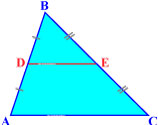
A triangle midsegment is parallel to one of the triangle's sides and is equal to half the length of that side.
; -
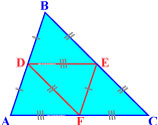
The three midsegments divide the triangle into four congruent triangles: ADF, DBE, ECF, and DEF.
-
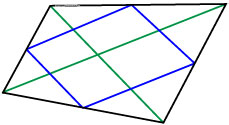
The midpoints of the sides of any convex quadrilateral form the vertices of a parallelogram.
-
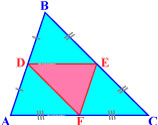
The midsegments of a triangle form a triangle whose perimeter is half that of the original triangle.


- Quick facts
- Tables
- Formulas
- Geometry formulas
- Math theory
