


Formulas and properties of logarithms: complete cheat sheet for the EGE and OGE
Logarithm is the exponent to which the base must be raised to get a given number: logab = c if ac = b. Basic properties: log(x·y) = log x + log y, log(x/y) = log x − log y, log xn = n·log x. Types: natural (ln, base e ≈ 2.718) and decimal (lg, base 10).
Formulas and properties of logarithms — a basic cheat sheet for schoolchildren and students. Here you will find: the definition of a logarithm, the main properties (logarithm of a product, quotient, power, root), the change of base formula, the derivative of a logarithm, as well as types of logarithms — natural (ln) and decimal (lg). The material is suitable for preparing for the EGE and OGE, as well as for first-year students.
Suitable for printing and use in exams
About the author
The material was prepared by Alexey Pavlov, a mathematics teacher. The formulas and properties of logarithms have been tested in practice while preparing students for the EGE and OGE.
On this page:
Definition of logarithm
Logarithm is a mathematical function inverse to exponentiation. The logarithm of a number b to base a (loga b) is the exponent to which a must be raised to obtain b.
Conditions: b > 0, a > 0, a ≠ 1.
How to solve a logarithm in practice:
To find the value of log₂8, answer the question: "To what power must 2 be raised to get 8?" Answer: 2³ = 8, so log₂8 = 3.
Similarly: log₃81 = 4, because 3⁴ = 81.
Types of logarithms
Logarithm of a positive number b to base a (loga b) is the exponent to which a must be raised to obtain b.
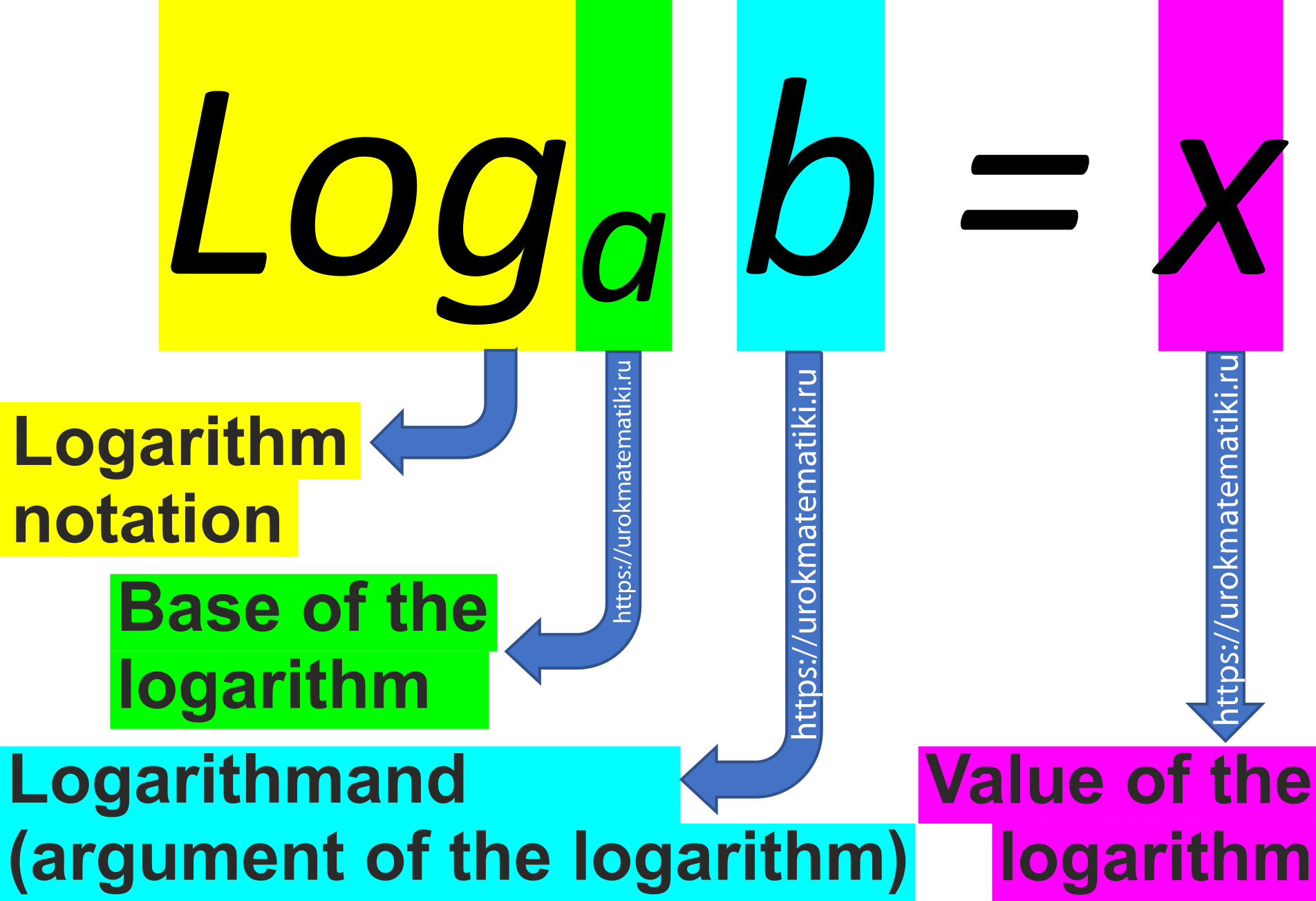
Examples of logarithms:
(logarithm of to base 2), because
(logarithm of to base 7), because
(logarithm of to base 5), because
Decimal logarithm

Decimal logarithm — logarithm to base 10.
— Decimal logarithm
Examples of decimal logarithms:
— decimal logarithm of one hundred, because 10² = 100.
, because 10³ = 1000.
Natural logarithm
— natural logarithm (logarithm to base e, ), where e ≈ 2.718.
Example: ln(e²) = 2, because e² = e².
Important: The natural logarithm is often used in higher mathematics, physics, and economics.
Formulas and properties of logarithms
For any , and , , the following properties of logarithms hold.
Basic logarithmic identity
A base a raised to the power of a logarithm with base a equals b.
Example: Example: 2log₂8 = 2³ = 8.
Logarithm of one
Logarithmic zero. Whatever the base of the logarithm, if the argument is 1, the logarithm is always 0.
Example: Example: log₅1 = 0, because 5⁰ = 1.
Logarithm of a number equal to the base
Logarithmic one. If the argument and the base of the logarithm are the same, the value of the logarithm is one.
Example: Example: log₇7 = 1, because 7¹ = 7.
Logarithm of the reciprocal of the base
If the argument of the logarithm is the reciprocal of the base, the value of the logarithm is -1.
Example: Example: log₃(1/3) = -1, because 3⁻¹ = 1/3.
Logarithm of the product of two positive numbers
Sum of logarithms. When multiplying numbers under the logarithm, you can turn them into a sum of two logarithms with the same base.
Example: Example: log₂(8·4) = log₂8 + log₂4 = 3 + 2 = 5.
Logarithm of a quotient
Logarithm of a quotient. When dividing numbers, we get the difference of two logarithms with the same base.
Example: Example: log₂(8/4) = log₂8 - log₂4 = 3 - 2 = 1.
Logarithm of a power of a positive number
Logarithm of a power of a positive number equals the product of the exponent and the logarithm of that number.
Example: Example: log₂8³ = 3·log₂8 = 3·3 = 9.
Logarithm of a root of a number
Logarithm of a root equals the quotient of the logarithm of the radicand divided by the index of the root.
Example: Example: log₅√25 = log₅25 / 2 = 2/2 = 1.
Base of the logarithm raised to a power
Example: Example: log₄64 = log₂64 / 2 = 6/2 = 3.
Example: Example: log₂8 = log₄8² = log₄64 = 3.
Change of base formula
Allows you to switch from a logarithm with one base to a logarithm with another base.
Example: Example: log₂8 = log₁₀8 / log₁₀2 ≈ 0.903 / 0.301 = 3.
Derivative of a logarithm
Derivative of a logarithmic function with respect to its base equals one divided by the product of the sublogarithmic function and the natural logarithm of the base.
Example: Example: (log₂x)' = 1/(x·ln2).
Graph of logarithms
By moving the slider, you change the base of the logarithm, which affects the shape of the graph. With a = e (≈ 2.718) you get the natural logarithm, with a = 10 — the decimal one.
y = log2 x
Frequently asked questions about logarithms
What is a logarithm in simple words?
What is the difference between decimal and natural logarithm?
What basic properties of logarithms do you need to know for the EGE?
How do you change from one base of a logarithm to another?
What is the logarithm of 1?
What is the logarithm base 2?
Can you calculate the logarithm of a negative number?
How do you solve logarithms?
📚 See also:
- • Table of natural logarithms
- • Table of decimal logarithms
- • Formulas and properties of powers
- • Formulas and properties of roots
- • Abbreviated multiplication formulas: FSU table with examples
- • Trigonometric formulas
- • Formulas and properties of arithmetic progression
- • Formulas and properties of geometric progression
- Quick facts
- Tables
- Formulas
- Geometry formulas
- Math theory
