


Formulas for the areas of figures
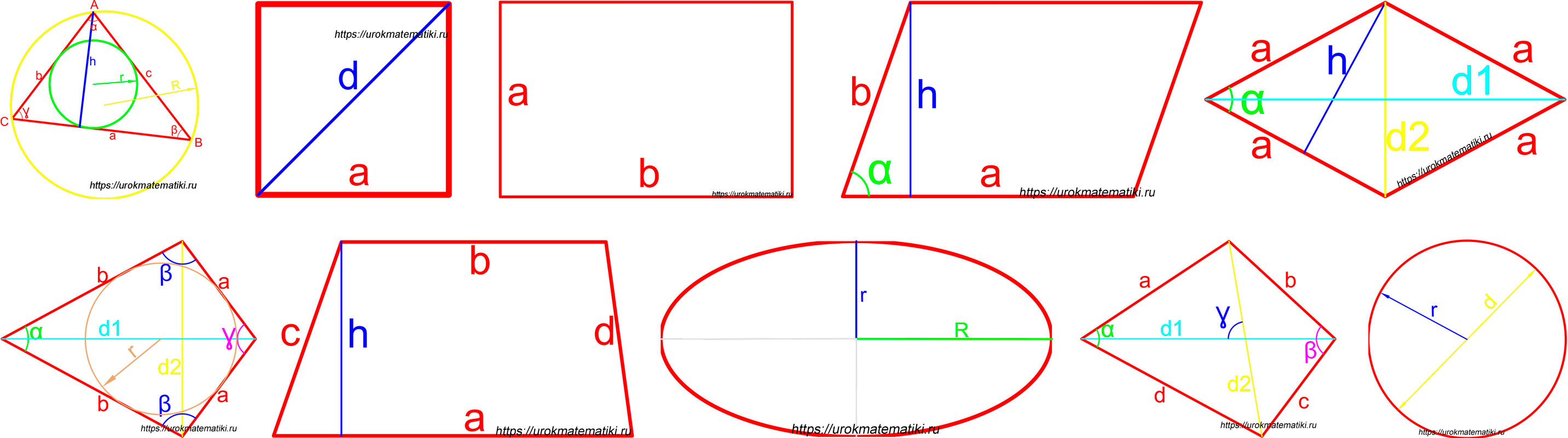
The area of a geometric figure is a numerical characteristic of a geometric figure showing the size of the figure (part of the surface bounded by the closed contour of the figure). The area is expressed as the number of square units it contains.
- formulas for the area of a triangle
- formulas for the area of a square
- formula for the area of a rectangle
- formulas for the area of a parallelogram
- formulas for the area of a rhombus
- formulas for the area of a trapezoid
- formulas for the area of a kite
- formulas for the area of an arbitrary convex quadrilateral
- formulas for the area of a circle
- formula for the area of an ellipse
Formulas for the area of a triangle
Main formulas for the area of a triangle
1. By side and height: S = ½ × a × h
2. By three sides (Heron's formula): S = √(p(p-a)(p-b)(p-c)), where p = (a+b+c)/2
3. By two sides and the angle: S = ½ × a × b × sin(γ)

Formula for the area of a triangle by side and height

The area of a triangle equals half the product of the length of a side of the triangle and the length of the height drawn to that side.
,where a is one of the sides of the triangle, h is the height drawn to the side of the triangle.
Formula for the area of a triangle by three sides

Heron's formula is a formula for computing the area of a triangle S from the lengths of its sides a, b, c.
,where p is the semiperimeter of the triangle:
a, b, c are the sides of the triangle.
Formula for the area of a triangle by two sides and the angle between them

The area of a triangle equals half the product of two of its sides multiplied by the sine of the angle between them.
,where a, b are the sides of the triangle,
γ is the angle between the sides a and b.
Formula for the area of a triangle by three sides and the radius of the circumscribed circle
 ,
a, b, c are the sides of the triangle,
R is the radius of the circumscribed circle.
For a right triangle, the sides are related by the Pythagorean theorem: a² + b² = c², where a and b are the legs, and c is the hypotenuse.
Formula for the area of a triangle by three sides and the radius of the inscribed circle

The area of a triangle equals the product of the semiperimeter of the triangle and the radius of the inscribed circle.
,where S is the area of the triangle,
r is the radius of the inscribed circle,
p is the semiperimeter of the triangle:
Formulas for the area of a square
Albert Einstein and the <b>formula for the area of a square</b>
 Once upon a time, in a certain city, there lived a scientist named Albert Einstein. He was known for his discoveries in physics and mathematics, but one day he faced a problem that seemed unsolvable to him.
One day Albert decided to conduct an experiment to prove his theory that the area of a square equals the square of its side length. But no matter how he tried, he could not find a way to do it. He conducted many experiments, used various methods and tools, but all in vain.
In the end, he decided to ask his fellow scientists for help. When he came to them, they were surprised by his request. They told him that it was impossible, because the area of a square cannot be expressed as a formula. But Albert did not give up. He continued to look for a solution to this problem.
And one day, when he was sitting in his office, it dawned on him. He realized that the area of a square can be expressed as a formula if one uses not the length of the side of the square, but its diagonal. And so, at last, Albert found the solution to his problem. He created a formula that allowed him to compute the area of a square from its diagonal. It was a real breakthrough in science!
Since then, Albert became known as the creator of the formula for the area of a square. His discovery became one of the most important in the history of mathematics and physics.

Formula for the area of a square by side length

The area of a square equals the square of the length of its side.
,where S is the area of the square,
a is the length of the side of the square.
Formula for the area of a square by diagonal length

The area of a square equals half the square of the length of its diagonal.
,where S is the area of the square,
d is the length of the diagonal of the square.
Formula for the area of a rectangle
Once upon a time there was a scientist who could not memorize the formula...
Once upon a time there was a scientist named Ivan Ivanovich. He was very smart and talented, but he had one problem — he could not memorize formulas.
One day he needed to compute the area of a rectangle, and he began to think: "The area of a rectangle equals the length multiplied by the width." But as soon as he began to write the formula, his thoughts scattered, and he forgot what he wanted to write.
Then Ivan Ivanovich decided to go to his friend, who was a mathematical genius. He asked him how to compute the area of a rectangle. The friend answered: "The area of a rectangle equals twice the length times the width." Ivan Ivanovich was very surprised, because he had always thought that the area equals the length multiplied by the width. But the friend explained to him that if we double the length, we get double the area, and if we double the width, we get triple the area.
Since then, Ivan Ivanovich began to memorize formulas with the help of pictures. He drew a rectangle on paper, then divided it into two parts and drew another rectangle inside the first one. Then he wrote the area formula for each rectangle and combined them together. Now Ivan Ivanovich could easily compute the area of a rectangle and not forget the formulas. And he understood that this not only helped him in his studies, but also made him smarter and more resourceful.

The area of a rectangle equals the product of the lengths of two of its adjacent sides.
,where S is the area of the rectangle,
a, b are the lengths of the sides of the rectangle.
Formulas for the area of a parallelogram
A parallelogram is a quadrilateral in which opposite sides are parallel.

Formula for the area of a parallelogram by side length and height

The area of a parallelogram equals the product of the length of its side and the length of the height dropped to that side.
,where S is the area of the parallelogram,
a, h are the lengths of the sides of the parallelogram.
Formula for the area of a parallelogram by two sides and the angle between them

The area of a parallelogram equals the product of the lengths of its sides multiplied by the sine of the angle between them.
,where S is the area of the parallelogram,
a, b are the lengths of the sides of the parallelogram,
α is the angle between the sides of the parallelogram.
Formula for the area of a parallelogram by two diagonals and the angle between them

The area of a parallelogram equals half the product of the lengths of its diagonals multiplied by the sine of the angle between them.
,where S is the area of the parallelogram,
d1, d2 are the lengths of the diagonals of the parallelogram,
β, γ is the angle between the diagonals of the parallelogram.
Formulas for the area of a rhombus

Formula for the area of a rhombus by side length and height

The area of a rhombus equals the product of the length of its side and the length of the height dropped to that side.
,where S is the area of the rhombus,
a is the length of the side of the rhombus,
h is the length of the height of the rhombus.
Formula for the area of a rhombus by side length and angle

The area of a rhombus equals the product of the square of the length of its side and the sine of the angle between the sides of the rhombus.
,where S is the area of the rhombus,
a is the length of the side of the rhombus,
α is the angle between the sides of the rhombus.
Formula for the area of a rhombus by the lengths of its diagonals

The area of a rhombus equals half the product of the lengths of its diagonals.
,where S is the area of the rhombus,
d1, d2 are the lengths of the diagonals of the rhombus.
Formulas for the area of a trapezoid
A trapezoid is a quadrilateral in which two (a, b) sides are parallel (the bases), and the other two (c, d) sides are not parallel (the lateral sides).

Heron's formula for a trapezoid
 ,
where S is the area of the trapezoid,
a, b are the lengths of the bases of the trapezoid,
c, d are the lengths of the lateral sides of the trapezoid,
is the semiperimeter of the trapezoid.
Formula for the area of a trapezoid by the lengths of its bases and height

The area of a trapezoid equals the product of the half-sum of its bases and the height.
,where S is the area of the trapezoid,
a, b are the lengths of the bases of the trapezoid,
h is the height of the trapezoid.
Formulas for the area of a kite
A kite is a convex quadrilateral consisting of two different isosceles triangles with a common base, whose vertices lie on opposite sides of that base.

Formula for the area of a kite by two unequal sides and the angle between them

The area of a kite equals the product of the lengths of the unequal sides and the sine of the angle between them.
,where S is the area of the kite,
a, b are the lengths of the unequal sides of the kite,
β is the angle between the unequal sides of the kite.
Formula for the area of a kite by the equal sides and the angle between them

The area of a kite equals the half-sum of the products of each pair of equal sides and the sine of the angle between them.
,where S is the area of the kite,
a, b are the lengths of the sides of the kite,
α is the angle between the equal sides b,
γ is the angle between the equal sides a.
Formula for the area of a kite by two unequal sides and the radius of the inscribed circle

The area of a kite equals the product of the sum of the unequal sides and the radius of the inscribed circle.
,where S is the area of the kite,
a, b are the lengths of the unequal sides of the kite,
r is the radius of the inscribed circle.
Formula for the area of a kite by two diagonals

The area of a kite equals half the product of the lengths of its two diagonals.
,where S is the area of the kite,
d1, d2 are the diagonals of the kite.
Formulas for the area of an arbitrary convex quadrilateral

Formula for the area of an arbitrary convex quadrilateral by the lengths of the diagonals and the angle between them

The area of an arbitrary convex quadrilateral equals half the product of its diagonals multiplied by the sine of the angle between them.
,where S is the area of the quadrilateral,
d1, d2 are the diagonals of the quadrilateral,
γ is any of the four angles between the diagonals.
Formula for the area of an arbitrary convex quadrilateral by the lengths of the sides and the values of the opposite angles
 ,
where S is the area of the quadrilateral,
a, b, c, d are the lengths of the sides of the quadrilateral,
is the semiperimeter of the quadrilateral,
is the half-sum of two opposite angles of the quadrilateral.
Formula for the area of a cyclic quadrilateral (Brahmagupta's formula)

If a circle can be circumscribed around a quadrilateral, then its area equals
,where S is the area of the quadrilateral,
a, b, c, d are the lengths of the sides of the quadrilateral,
is the semiperimeter of the quadrilateral.
Formula for the area of a quadrilateral with an inscribed circle

If a circle can be inscribed in a quadrilateral, then its area equals:
,where S is the area of the quadrilateral,
r is the radius of the inscribed circle,
is the semiperimeter of the quadrilateral.
Formula for the area of a quadrilateral with both an inscribed and a circumscribed circle

If a circle can be inscribed in a quadrilateral and a circle can also be circumscribed around it, then its area equals:
,where S is the area of the quadrilateral,
a, b, c, d are the lengths of the sides of the quadrilateral.
Formulas for the area of a circle

Formula for the area of a circle via the radius
The area of a circle equals the product of the square of the radius and pi.
 ,
where S is the area of the circle,
r is the radius of the circle.
Formula for the area of a circle via the diameter

The area of a circle equals one quarter of the product of the square of the diameter and pi.
,where S is the area of the circle,
d is the diameter of the circle.
Area of a circular segment

Area of a circular segment via the angle in degrees.
,where S is the area of the circular segment,
R is the radius of the circle,
α° is the angle in degrees.
Area of a circular segment via the angle in radians.
,where S is the area of the circular segment,
R is the radius of the circle,
α° is the angle in radians.
Formula for the area of an ellipse

The area of an ellipse equals the product of the lengths of the major and minor semiaxes of the ellipse and pi.
,where S is the area of the ellipse,
a is the length of the major semiaxis of the ellipse,
b is the length of the minor semiaxis of the ellipse.
- Quick facts
- Tables
- Formulas
- Geometry formulas
- Math theory
