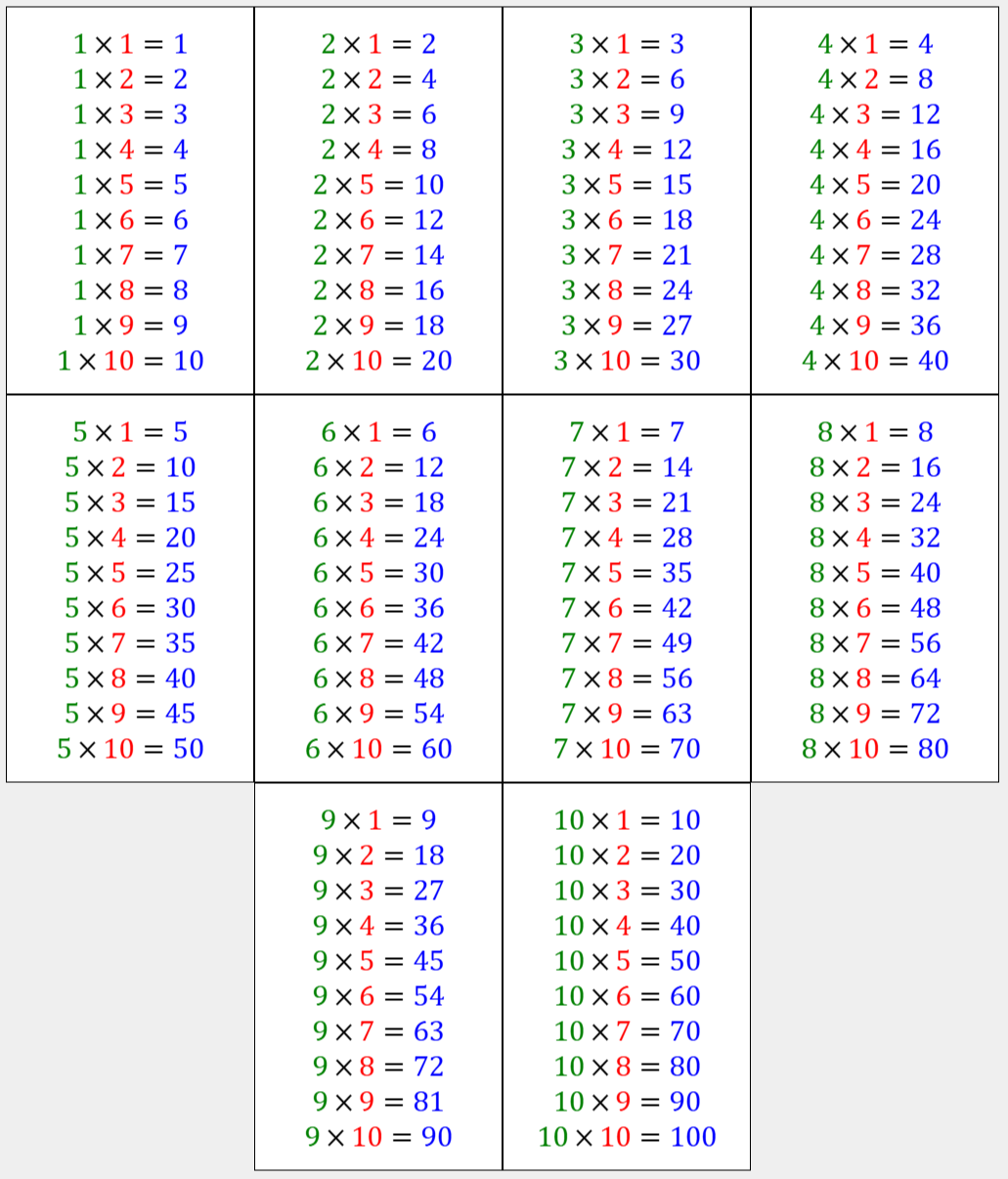
Multiplication table from 1 to 10
A multiplication table is a grid where rows and columns are labeled with factors (1, 2, 3, 4, 5…), and the cells contain their products. Learning the multiplication table is a fundamental part of the school mathematics curriculum. This page features the complete multiplication table from 1 to 10, a table of squares, and a download link in PNG format.
What do you need?
- 📊 Multiplication table from 1 to 10 — Multiplication table from 1 to 10 — right here on this page
- 📥 Download table as PNG — Download table as PNG — for printing
- 🔢 Table of squares — Table of squares — squares of numbers from 1 to 20
- 📈 Multiplication table (up to 20) — Multiplication table (up to 20) — extended version
- 📚 How to learn the multiplication table quickly — How to learn the multiplication table quickly — step-by-step guide
- 🎯 Online trainer — Online trainer — test your knowledge
- 📐 Table of squares from 1 to 100 — Table of squares from 1 to 100 — complete reference
About this guide
- The tables were created based on standard primary school mathematics teaching methods.
- All values have been verified and correspond to the classic multiplication table.
- The material was prepared by a mathematics teacher and is intended for students, parents, and teachers.
Download multiplication table
Multiplication table from 1 to 10
The classic multiplication table taught in primary school. Each block represents one factor (green); the second factor is highlighted in red, and the result in blue.
How to read the table: the first block contains multiplication examples for 1, the second for 2, and so on up to 10. Within each block, the examples appear in order: from multiplying by 1 to multiplying by 10.
Table of squares of numbers from 1 to 20
The square of a number is the result of multiplying the number by itself. The table of squares is often used alongside the multiplication table. The full table of squares from 1 to 100 is available on a separate page: Table of squares from 1 to 100.
| Number | 1 | 2 | 3 | 4 | 5 | 6 | 7 | 8 | 9 | 10 |
|---|---|---|---|---|---|---|---|---|---|---|
| Square | 1 | 4 | 9 | 16 | 25 | 36 | 49 | 64 | 81 | 100 |
| Number | 11 | 12 | 13 | 14 | 15 | 16 | 17 | 18 | 19 | 20 |
| Square | 121 | 144 | 169 | 196 | 225 | 256 | 289 | 324 | 361 | 400 |
📚 What's next:
- • Extended multiplication table up to 20 — Extended multiplication table up to 20 — for quick mental math
- • How to learn the multiplication table quickly — How to learn the multiplication table quickly — methods, tips, and exercises
- • Online trainer "Multiplication table" — Online trainer "Multiplication table" — test your knowledge
- • Table of squares from 1 to 100 — Table of squares from 1 to 100 — complete reference
- • Bradis table — Bradis table — for trigonometry
Frequently asked questions about the multiplication table
What is the multiplication table?
How can I learn the multiplication table quickly?
Where can I download a printable multiplication table?
What is a table of squares used for?
How does the multiplication table differ from the Pythagoras table?
Compiled by: Alexey Pavlov, mathematics teacher.
Source: standard school mathematics curriculum, classic multiplication table.
Last updated: 16.11.2026.
- Quick facts
- Tables
- Formulas
- Geometry formulas
- Math theory