


Formulas for the volume of figures
The volume of a figure is a quantitative characteristic of the space occupied by a body or substance. The volume of a body or the capacity of a vessel is determined by its shape and linear dimensions.
- volume of a cube
- volume of a prism
- volume of a parallelepiped
- volume of a rectangular parallelepiped
- volume of a pyramid
- volume of a cylinder
- volume of a cone
- volume of a sphere
Volume of a cube

Volume of a prism
A prism is a polyhedron, two faces of which are congruent (equal) polygons lying in parallel planes, and the remaining faces are parallelograms having common sides with these polygons.

The volume of a prism equals the product of the area of the base of the prism and the height.
If the base is:
- a triangle, find the area of the triangle,
- a square, then the area of the square,
- an arbitrary figure, find the area of that arbitrary figure.
where V is the volume of the prism,
Sо is the area of the base of the prism,
h is the height of the prism — the distance between its bases. For a right prism, in which all edges are perpendicular to the bases, this is any of the edges.
Volume of a parallelepiped
A parallelepiped is a polyhedron with six faces, each of which is a parallelogram.

The volume of a parallelepiped equals the product of the area of the base of the parallelepiped and the height.
,where V is the volume of the parallelepiped,
Sо is the area of the base of the parallelepiped,
h is the height of the parallelepiped — the distance between its bases.
Volume of a rectangular parallelepiped

Volume of a pyramid
A pyramid is a polyhedron whose base is an arbitrary polygon, and all faces are triangles with a common vertex, which is the apex of the pyramid.
Volume of a pyramid with an arbitrary base

The volume of a pyramid equals one third of the product of the area of the base and the height.
,where V is the volume of the pyramid,
S is the area of the base of the pyramid,
h is the height of the pyramid.
Volume of a truncated pyramid
A truncated pyramid is the part of a pyramid between its base and this section. A section parallel to the base of the pyramid divides the pyramid into two parts.

The volume of a truncated pyramid equals one third of the product of the height h and the sum of the areas of the top base S1, the bottom base of the truncated pyramid S2, and the geometric mean between them.
,where V is the volume of the truncated pyramid,
S1 is the area of the top base of the truncated pyramid,
S2 is the area of the bottom base of the truncated pyramid,
h is the height of the truncated pyramid.
Volume of a regular pyramid
A regular pyramid is a pyramid whose base is a regular polygon and whose height passes through the center of the circle inscribed in the base.
 ,
where V is the volume of the pyramid,
a is the side of the base of the pyramid,
n is the number of sides of the polygon at the base,
h is the height of the regular pyramid.
Volume of a regular triangular pyramid
A regular triangular pyramid is a pyramid whose base is an equilateral triangle and whose faces are equal isosceles triangles.
 ,
where V is the volume of the regular triangular pyramid,
a is the side of the base of the pyramid,
h is the height of the regular triangular pyramid.
Volume of a regular quadrangular pyramid
A regular quadrangular pyramid is a pyramid whose base is a square and whose faces are equal isosceles triangles.
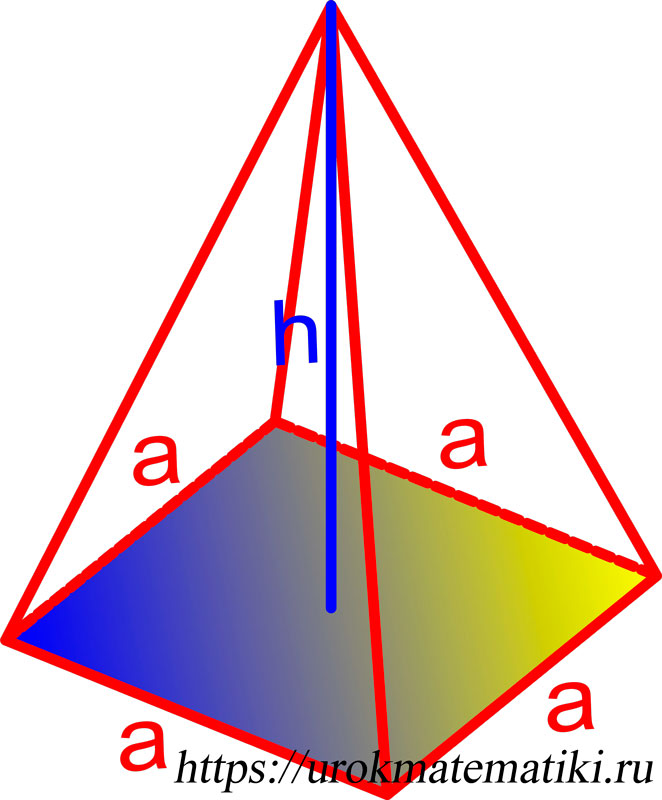
The volume of a regular quadrangular pyramid equals one third of the product of the height of the pyramid and the cube of the side of the base of the pyramid.
,where V is the volume of the regular quadrangular pyramid,
a is the side of the base of the pyramid,
h is the height of the regular quadrangular pyramid.
Volume of a tetrahedron
A tetrahedron is a pyramid in which all faces are equilateral triangles.

The volume of a tetrahedron equals one twelfth of the product of the cube of the length of a face of the tetrahedron and the square root of two.
,where V is the volume of the tetrahedron,
a is any of the faces of the tetrahedron.
Volume of a cylinder
A cylinder is a geometric body bounded by a cylindrical surface and two parallel planes intersecting it.

The volume of a cylinder equals the product of the area of its base and the height.
,where V is the volume of the cylinder,
S is the area of the base of the cylinder,
R is the radius of the cylinder,
π is pi ≈ 3.14159265.
Volume of a cone
A cone is a body obtained by combining all rays emanating from a single point (the apex of the cone) and passing through a flat surface.

The volume of a cone equals one third of the product of the area of its base and the height.
,where V is the volume of the cone,
S is the area of the base of the cone,
R is the radius of the base of the cone,
π is pi ≈ 3.14159265.
Volume of a sphere
A sphere is the set of all points in space that are located at a distance from the center no greater than a given value.

The volume of a sphere equals four thirds of the product of pi and the cube of the radius of the sphere.
,where V is the volume of the sphere,
R is the radius of the sphere,
π is pi ≈ 3.14159265.
- Quick facts
- Tables
- Formulas
- Geometry formulas
- Math theory
