


Triangle
A triangle is a figure consisting of three points that do not lie on one straight line, and three segments connecting these points in pairs. The points are called the vertices of the triangle, and the segments are called its sides.

- types of triangles
- vertices, angles, and sides of a triangle
- medians of a triangle
- bisectors of a triangle
- altitudes of a triangle
- circle inscribed in a triangle
- circle circumscribed around a triangle
- relation between the inscribed and circumscribed circles of a triangle
- midline of a triangle
- perimeter of a triangle
- formulas for the area of a triangle
- congruence of triangles
- similarity of triangles
- right triangles
Types of triangles

By the size of the angles
Acute triangle

— all angles of the triangle are acute.
Obtuse triangle

— one of the angles of the triangle is obtuse (greater than 90°).
Right triangle

— one of the angles of the triangle is right (equal to 90°).
By the number of equal sides
Scalene triangle

— all three sides are unequal.
Isosceles triangle

— two sides are equal.
Equilateral (regular) triangle

— all three sides are equal.
Vertices, angles, and sides of a triangle

Properties of angles and sides of a triangle
The sum of the angles of a triangle is 180°
In a triangle, the greater angle lies opposite the greater side, and vice versa. Equal angles lie opposite equal sides
- if , then
- if , then
The sum of the lengths of any two sides of a triangle is greater than the length of the remaining side
Law of sines
The sides of a triangle are proportional to the sines of the opposite angles.
Law of cosines
The square of any side of a triangle equals the sum of the squares of the other two sides minus twice the product of these sides and the cosine of the angle between them.
Projection theorem
For an acute triangle:
Formulas for computing the lengths of the sides of a triangle
Formulas for the sides in terms of the medians
Medians of a triangle
A median of a triangle is a segment inside the triangle that connects a vertex of the triangle to the midpoint of the opposite side.

Properties of the medians of a triangle
- The medians of a triangle intersect at one point. The intersection point of the medians is called the centroid.
- At the intersection point, the medians of a triangle are divided in the ratio of two to one (2:1)
- A median of a triangle divides the triangle into two equal-area parts
- The triangle is divided by three medians into six equal-area triangles
- From the vectors forming the medians, one can construct a triangle
Formulas for the medians of a triangle
Formulas for the medians of a triangle in terms of the sides
Bisectors of a triangle
The bisector of an angle is a ray with its origin at the vertex of the angle, dividing the angle into two equal angles.

Properties of the bisectors of a triangle
- The bisectors of a triangle intersect at one point equidistant from the three sides of the triangle — the center of the inscribed circle.
- A bisector of a triangle divides the opposite side into segments proportional to the adjacent sides of the triangle
- The angle between the bisectors of the interior and exterior angles of a triangle at one vertex is 90°
The angle between and - If two bisectors are equal in a triangle, the triangle is isosceles.
Formulas for the bisectors of a triangle
Formulas for the bisectors of a triangle in terms of the sides
where is the semiperimeter of the triangle.
Formulas for the bisectors of a triangle in terms of two sides and the angle
Altitudes of a triangle

The altitude of a triangle is a perpendicular dropped from a vertex of the triangle to the line containing the opposite side.
Depending on the type of triangle, the altitude may be located:
- inside the triangle — for an acute triangle;
- coinciding with one of its sides — for a leg of a right triangle;
- outside the triangle — for the acute angles of an obtuse triangle.
Properties of the altitudes of a triangle
- The altitudes of a triangle intersect at one point called the orthocenter of the triangle.
- If two altitudes are equal in a triangle, the triangle is isosceles.
Formulas for the altitudes of a triangle
Formulas for the altitudes of a triangle in terms of a side and an angle
Formulas for the altitudes of a triangle in terms of a side and the area
Formulas for the altitudes of a triangle in terms of two sides and the radius of the circumscribed circle
Circle inscribed in a triangle
A circle is called inscribed in a triangle if it is tangent to all three of its sides.

Properties of the circle inscribed in a triangle
- The center of the circle inscribed in a triangle lies at the intersection of the bisectors of the interior angles of the triangle.
- A circle can be inscribed in any triangle, and only one.
Formulas for the radius of the circle inscribed in a triangle
The radius of the circle inscribed in a triangle equals the ratio of the area of the triangle to its semiperimeter
The radius of the circle inscribed in a triangle in terms of three sides
Formulas for the altitudes of a triangle in terms of two sides and the radius of the circumscribed circle
Circle circumscribed around a triangle
A circle is called circumscribed around a triangle if it contains all the vertices of the triangle.

Properties of the circle circumscribed around a triangle
- The center of the circle circumscribed around a triangle lies at the intersection of the perpendicular bisectors of its sides.
- A circle can be circumscribed around any triangle, and only one.
Properties of angles
The center of the circumscribed circle lies inside an acute triangle, outside an obtuse triangle, and at the midpoint of the hypotenuse of a right triangle.
Formulas for the radius of the circle circumscribed around a triangle
Radius of the circumscribed circle in terms of three sides and the area
Radius of the circumscribed circle in terms of the area and three angles
Radius of the circumscribed circle in terms of a side and the opposite angle (law of sines)
Relation between the inscribed and circumscribed circles of a triangle

Formulas for the radius of the circle circumscribed around a triangle
If d is the distance between the centers of the inscribed and circumscribed circles, then
Radius of the circumscribed circle in terms of the area and three angles
Midline of a triangle
The midline of a triangle is a segment connecting the midpoints of two sides of the triangle.

Properties of the midline of a triangle
- Any triangle has three midlines.
- The midline of a triangle is parallel to the base and equals half of it.
; ;
; ; - The midline cuts off a triangle similar to the given one, whose area equals a quarter of the area of the original triangle.
; ; - When all three midlines intersect, 4 equal triangles are formed, similar (even homothetic) to the original with coefficient 1/2.
;
;
;
Criteria
If a segment is parallel to one of the sides of a triangle and connects the midpoint of a side of the triangle with a point lying on another side of the triangle, then this segment is a midline.
Perimeter of a triangle

The perimeter of triangle ∆ABC equals the sum of the lengths of its sides.
Formulas for the area of a triangle

Formula for the area of a triangle by side and height

The area of a triangle equals half the product of the length of a side of the triangle and the length of the height drawn to that side.
,
,
,
where a, b, c are the sides of the triangle,
ha, hb, hc are the altitudes drawn to the sides a, b, c of the triangle.
Formula for the area of a triangle by three sides

Heron's formula is a formula for computing the area of a triangle S from the lengths of its sides a, b, c.
,where p is the semiperimeter of the triangle:
a, b, c are the sides of the triangle.
Formula for the area of a triangle by two sides and the angle between them

The area of a triangle equals half the product of two of its sides multiplied by the sine of the angle between them.
,
,
,
where a, b, c are the sides of the triangle,
γ is the angle between the sides a and b,
α is the angle between the sides b and c,
β is the angle between the sides a and c.
Formula for the area of a triangle by three sides and the radius of the circumscribed circle
 ,
a, b, c are the sides of the triangle,
R is the radius of the circumscribed circle.
Formula for the area of a triangle by three sides and the radius of the inscribed circle

The area of a triangle equals the product of the semiperimeter of the triangle and the radius of the inscribed circle.
,where S is the area of the triangle,
r is the radius of the inscribed circle,
p is the semiperimeter of the triangle:
Congruence of triangles

Definition
If two triangles ABC and A1B1C1 can be superimposed, then they are equal.
Properties
In congruent triangles, their corresponding elements are also equal. (In congruent triangles, equal angles lie opposite equal sides, and equal sides lie opposite equal angles.)
Criteria for congruence of triangles
By two sides and the angle between them
Theorem.
If two sides and the angle between them of one triangle are respectively equal to two sides and the angle between them of another triangle, then such triangles are congruent.By a side and two adjacent angles
Theorem.
If a side and two adjacent angles of one triangle are respectively equal to a side and two adjacent angles of another triangle, then such triangles are congruent.By three sides
Theorem.
If three sides of one triangle are respectively equal to three sides of another triangle, then such triangles are congruent.Similarity of triangles

Definition
Similar triangles are triangles in which the angles are respectively equal and the sides of one are respectively proportional to the sides of the other triangle.
,, и
where k is the similarity coefficient.
Criteria for similarity of triangles
- If two angles of one triangle are respectively equal to two angles of another, then such triangles are similar.
- If three sides of one triangle are proportional to three sides of another, then such triangles are similar.
- If two sides of one triangle are proportional to two sides of another, and the angles between these sides are equal, then such triangles are similar.
Properties
The areas of similar triangles are related as the square of the similarity coefficient:
Right triangles
A right triangle is a triangle in which one angle is right (i.e., equal to 90˚).
Properties of a right triangle
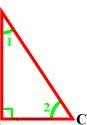 The sum of the two acute angles of a right triangle is 90°.
The sum of the angles of a triangle is 180°, and the right angle is 90°, therefore the sum of the two acute angles of a right triangle is .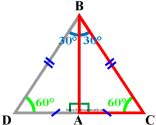
The leg of a right triangle lying opposite an angle of 30° equals half the hypotenuse (the hypotenuse is twice as long as the leg lying opposite an angle of 30°).
Consider a right triangle ABC, in which ∠ A is right, ∠ B = 30°, and hence ∠ C = 60°.
Let us prove that BC=2AC.
Attach to triangle ABC a triangle ABD equal to it, as shown in the figure.
We obtain triangle BCD, in which ∠ B = ∠ D = 60°, therefore DC = BC. But DC = 2AC. Consequently, BC = 2AC.The converse is also true: If a leg of a right triangle equals half the hypotenuse (or the hypotenuse is twice as long as the leg), then the angle lying opposite this leg is 30°.


Criteria for congruence of right triangles
Since in a right triangle the angle between the two legs is right, and any two right angles are equal, from the general criteria for congruence of triangles one can formulate specific criteria for congruence of right triangles.
- If the legs of one right triangle are respectively equal to the legs of another, then such triangles are congruent.
- If a leg and the acute angle adjacent to it of one right triangle are respectively equal to a leg and the acute angle adjacent to it of another, then such triangles are congruent.
- If the hypotenuse and an acute angle of one right triangle are respectively equal to the hypotenuse and an acute angle of another, then such triangles are congruent.
- If the hypotenuse and a leg of one right triangle are respectively equal to the hypotenuse and a leg of another, then such triangles are congruent.
Properties
The areas of similar triangles are related as the square of the similarity coefficient:
See also: Pythagorean theorem.
- Quick facts
- Tables
- Formulas
- Geometry formulas
- Math theory
