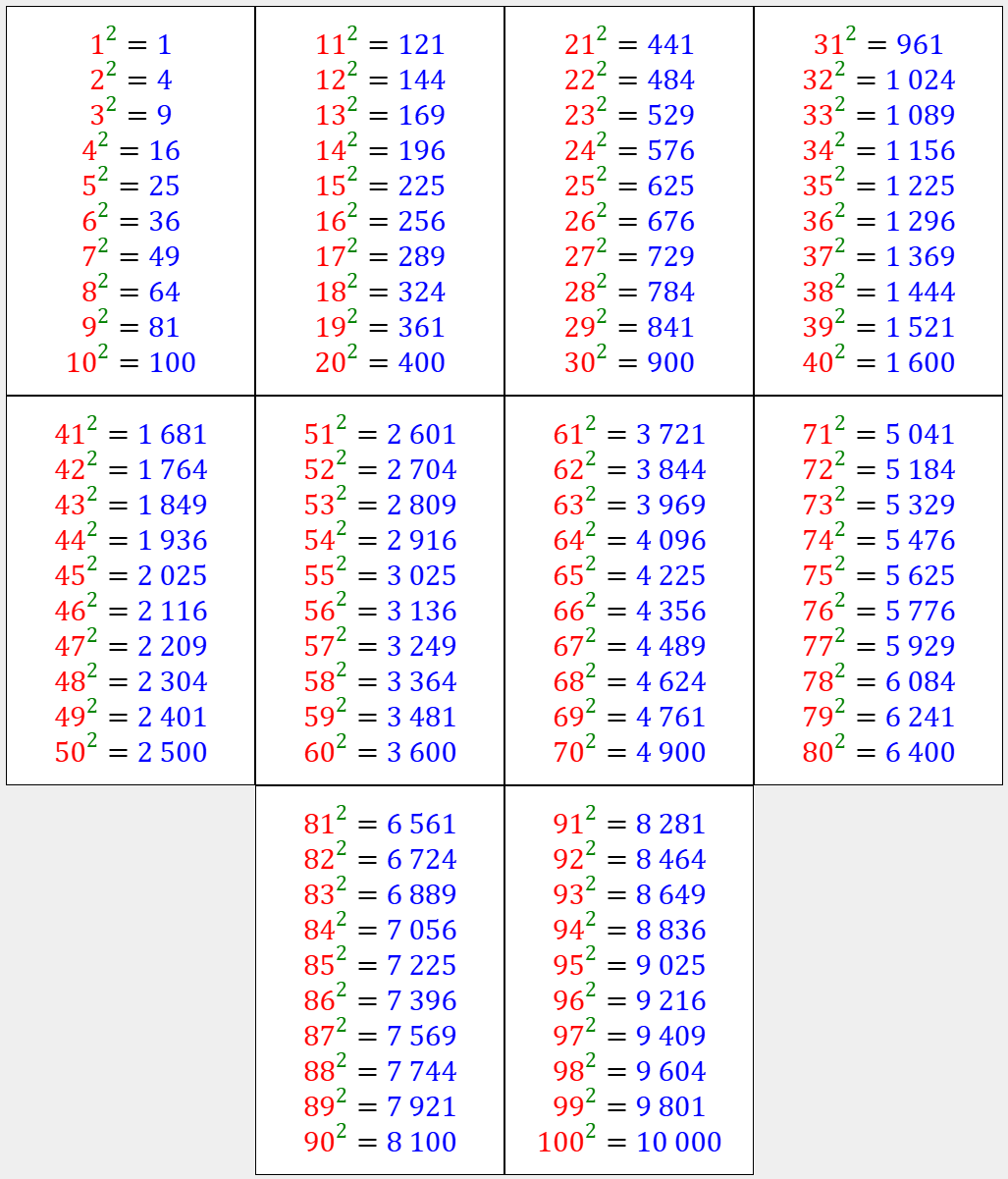

Table of squares of numbers from 1 to 100
The square of a number is that number raised to the second power, that is, multiplied by itself: n² = n × n. For example, 7² = 7 × 7 = 49. The table of squares helps you quickly find the result of squaring and solve problems in algebra, geometry, and physics.
What do you need?
- 📊 Complete table of squares from 1 to 100 — Complete table of squares from 1 to 100 — on this page
- 📥 Download table as PNG — Download table as PNG — for printing
- 🔢 Multiplication table — Multiplication table — basic table
- 📈 Extended multiplication table up to 20
- 📚 How to learn the multiplication table quickly
About this reference
- Values are calculated using the formula n² = n × n and verified with modern computational libraries.
- The table is compiled according to the standard methodology of teaching mathematics in secondary school.
- The material was prepared by a mathematics teacher and is intended for schoolchildren, students, and teachers.
Download the table of squares
The file is suitable for printing on A4 paper and using as a cheat sheet during lessons and exams.
Table of squares of numbers from 1 to 100
Each block contains 10 consecutive numbers and their squares. The values of numbers are highlighted in red, the exponent in green, the result in blue.
How to read the table: find a number in any block — its square is shown next to it. For example, 12² = 144, 25² = 625, 99² = 9801.
Examples of using the table of squares
Example 1. Find 16²
Find the number 16 in the table — its square is 256.
Answer: 16² = 256.
Example 2. Find 43²
In the table we see: 43² = 1849.
Answer: 43² = 1849.
Example 3. Find 87²
In the table: 87² = 7569.
Answer: 87² = 7569.
Why the table of squares is needed
- It allows you to quickly find the squares of numbers without a calculator.
- It is used to solve equations, problems on area, and the Pythagorean theorem.
- It helps when working with square roots: using the table, you can find which number squared equals a given value.
- It saves time on exams and tests.
- It trains memory and develops mental arithmetic skills.
Key patterns of squares
- A square cannot be negative: any number squared is ≥ 0.
- Squares of numbers ending in 5 always end in 25: 15² = 225, 25² = 625, 35² = 1225.
- Square of a sum: (a + b)² = a² + 2ab + b².
- Square of a difference: (a − b)² = a² − 2ab + b².
- Difference of squares: a² − b² = (a − b)(a + b).
How to memorize the table of squares
- Rely on "anchor" values: 10² = 100, 20² = 400, 30² = 900, 50² = 2500, 100² = 10000.
- Use the square of a sum formula: 12² = (10 + 2)² = 100 + 40 + 4 = 144.
- Practice regularly for 10–15 minutes a day using the online multiplication trainer.
📚 See also:
Frequently asked questions
What is a table of squares?
How do you use the table of squares?
Why is the table of squares needed at school?
How can I memorize squares of numbers quickly?
Where can I download the table of squares for printing?
Compiled by: Alexey Pavlov, mathematics teacher.
Source: standard school mathematics curriculum, classic tables of squares.
Last updated: 11.10.2026.
- Quick facts
- Tables
- Formulas
- Geometry formulas
- Math theory